

Warehouse operations are highly automated on paper. In reality, many critical process steps still depend on manual confirmation.
Pallets are scanned when they are picked up. Locations are confirmed when goods are put away. Operators trigger inventory updates and ERP postings explicitly, even though the physical action has already taken place.
The goal of many warehouse automation initiatives is therefore to move toward automated warehouse bookings, where systems update inventory and transactions automatically based on what actually happens on the warehouse floor rather than relying on manual confirmation steps.
This reliance on manual scanning is not a design flaw but a historical necessity. Systems have traditionally lacked a reliable way to understand what is happening on the warehouse floor in real time.
The Real Problem: Trusting Physical Events
In many warehouses, both reliable location data and accurate process confirmation remain a challenge. Even where some level of tracking exists, it is not used to drive transactions. Instead, warehouse processes still rely on manual scanning to confirm what has happened. This is where inefficiencies and human error are introduced.
Enterprise systems need high confidence before they automatically update inventory, post transactions, or trigger billing events. A missed scan or a delayed confirmation can cascade into reconciliation effort, inventory mismatches, and downstream errors.
This challenge becomes even more visible in higher rack areas and during inventory audits. Scanning pallets at upper rack levels is time-consuming and often requires additional equipment or manual verification later. As a result, inventory accuracy and audit processes frequently depend on manual confirmation steps that slow down operations and introduce inconsistencies. Many organizations accept this as the price of control, even though it introduces friction and variability.
The key question becomes: How can systems reliably detect what actually happened without asking humans to confirm it?
This is exactly the challenge a US FoodService Technology Provider was facing in their warehouse operations.

Turning Movement into Meaning
The objective was clear: eliminate manual scanning and confirmation steps entirely by enabling systems to automatically detect storage and retrieval operations as they happen.
The project was implemented together with Flowcate’s partner AMI Motion. In this setup, AMI Motion deployed a state-of-the-art Ultra-Wideband (UWB) system across the warehouse to provide highly precise real-time positioning. Flowcate’s DeepHub acted as the orchestration and integration layer, connecting location data with warehouse processes, ERP transactions, and analytics systems.
Together, the solution focused on turning physical movements directly into reliable system events rather than just visualizing positions.
A key aspect of this deployment was that no barcode or RFID scanning was required at any point in the process. Storage and retrieval were fully scanning-free. Instead, UWB AoA (Angle of Arrival) tracking was used to determine both the horizontal position and the height of the forklift by mounting a tag at the top of the vehicle. This enabled precise 3D tracking of the fork position within the rack structure.
Within DeepHub, rack- and bin-level geofences were defined to interpret movements based on precise spatial context. When a tracked forklift entered a specific rack zone and placed or retrieved a pallet, the system could automatically infer a put-away or pick event without requiring any manual confirmation.
As a result, the system could automatically determine where a pallet was stored or retrieved, including rack level, and trigger the corresponding booking directly in the system. This effectively removes scanning as a required step in storage and retrieval processes.
Eliminating Manual Scanning for Automated Warehouse Bookings
Once physical events are detected reliably, manual confirmation steps disappear.
Inventory updates and ERP postings are triggered automatically when goods are stored or retrieved, and billing-relevant movements are captured as part of the process rather than through additional confirmation steps.
This reduces errors and removes friction from workflows performed hundreds of times per day. Operators no longer spend time on repetitive scanning tasks and manual confirmations, allowing them to focus on material handling and exception management.
At the same time, operational cost decreases by reducing manual effort and eliminating error-driven rework, corrections, and inventory discrepancies.
Instead of relying on human confirmation, systems observe physical events directly and act on them in real time. Storage and retrieval processes become event-driven, keeping operations aligned with what is actually happening on the warehouse floor.
This creates a consistent operational picture across forklifts, processes, and systems, while also enabling more reliable performance analysis and continuous improvement.
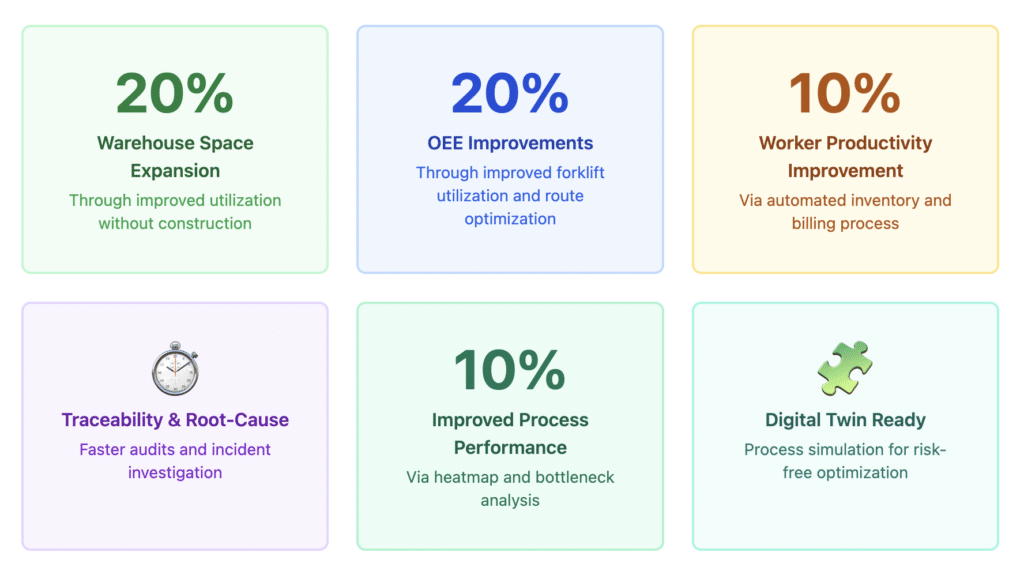
This shift from manual confirmation to event-driven operations translates directly into measurable operational impact.
A Practical Path Forward
The key takeaway is straightforward: the real breakthrough is not tracking assets, but replacing manual confirmation with system-driven events.
When systems can reliably detect where something happens and what operation takes place, manual scanning is no longer required. Bookings, inventory updates, and process steps happen automatically, based on real-world activity.
For warehouses, this means fewer errors, less manual effort, lower operating cost, and a more scalable operating model.
If you’re looking to eliminate manual scanning, automate bookings, and move toward automated, location-driven operations, this approach provides a proven path forward. Flowcate helps design and orchestrate these solutions across an open ecosystem, without locking you into a single technology.
Get in touch to learn how an open and interoperable location data foundation can power your use cases.